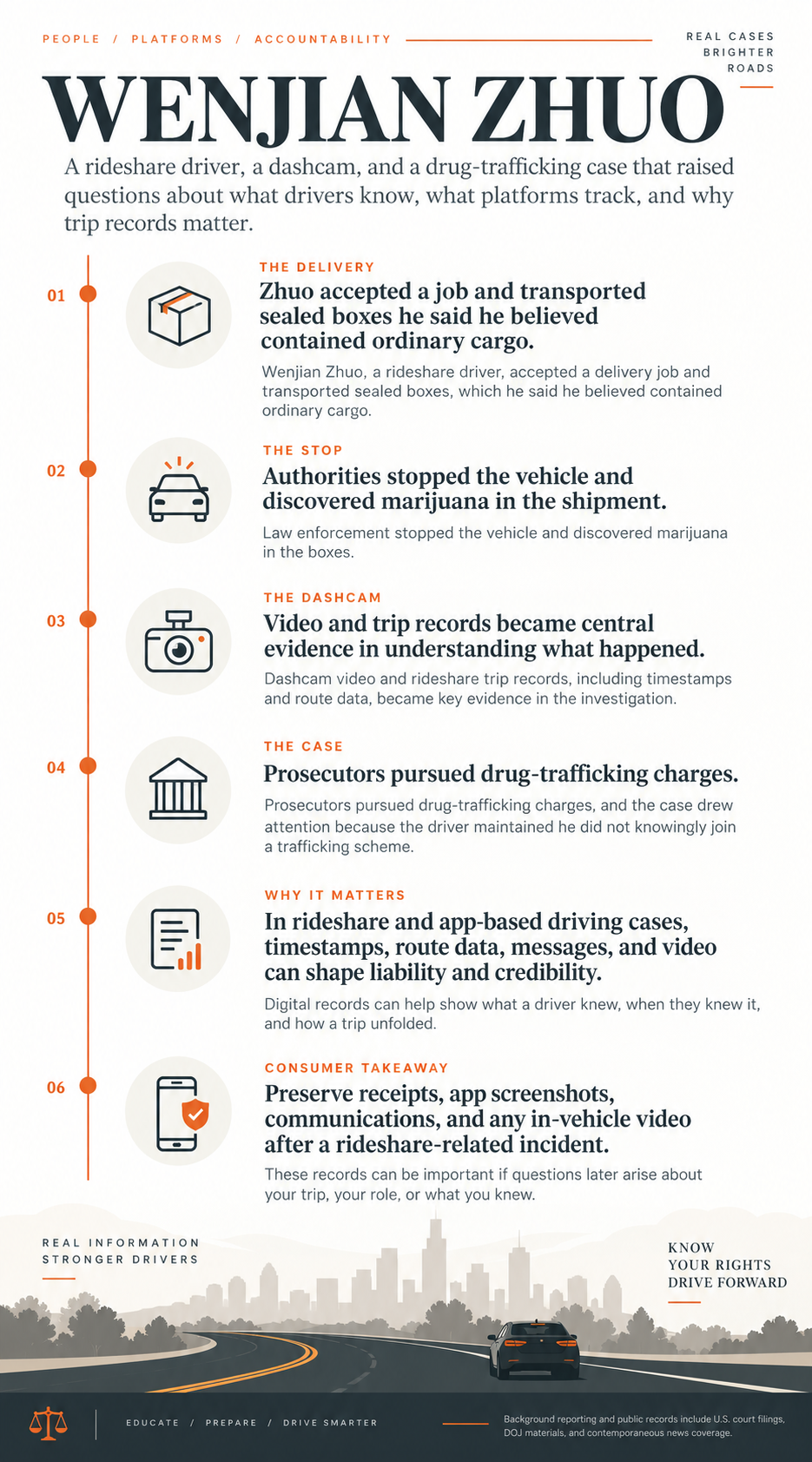
A driver accepted what he thought was a long-distance passenger job. Hours later, there was no passenger. Another man loaded boxes and luggage into his van instead. Twenty-two minutes after Zhuo drove away, Border Patrol stopped him and found roughly 207 pounds of marijuana inside.
The cameras Zhuo voluntarily gave investigators access to became evidence for both sides. They helped show that someone else loaded the cargo and helped identify that person. They also preserved a phone conversation prosecutors used to argue that Zhuo had begun to suspect what he was carrying and deliberately avoided confirming it.
For rideshare drivers and passengers, that tension is the part worth understanding. Digital records can protect you, hurt you, or do both at once. Either way, once an accident, assault, insurance dispute, or other serious incident occurs, the records surrounding the trip can become some of the most important evidence available.
RideClaim.co is not a law firm. This article is consumer information about rideshare records, evidence, and a publicly reported federal criminal case. RideClaim.co does not provide criminal-defense advice.
A Passenger Job That Turned Into a Cargo Run
In January 2025, Wenjian Zhuo was 31 and living in Queens. He had previously driven for Uber, but the trip involved in this case was not an Uber or Lyft trip. By then, he was arranging private transportation work through referrals and Chinese-language social platforms including WeChat and RedNote.
The customer told Zhuo to expect one passenger with several pieces of luggage. The agreed price was $940, including gas and tolls, with a $100 deposit paid in advance. Zhuo drove from New York City to a pickup point near the Akwesasne Mohawk Reservation, close to the Canadian border.
No passenger was waiting when he arrived.
According to the federal court record, another man, Eric Montour, arrived and helped load boxes, bags, luggage and a plastic bin into Zhuo's Toyota Sienna. Zhuo contacted the customer and was told that the passenger would not be traveling after all. The assignment had become a cargo delivery back toward New York City.
Zhuo accepted the change and left.
Within minutes, he called another driver for advice.
The 22 Minutes That Became the Center of the Case
The phone conversation captured by Zhuo's own camera system became critical at trial.
The May 2026 federal order denying his motion for acquittal describes Zhuo discussing the strange pickup, the unexpected cargo, the amount he was being paid and the possibility that the boxes contained marijuana. The government emphasized that he repeatedly mentioned marijuana, discussed how he might explain the situation if stopped, and declined his friend's suggestions that he inspect the packages.
Zhuo's defense argued that suspicion was not the same as knowledge. His lawyers also argued that he had legitimate reasons not to open sealed property entrusted to him and that he had only a short period of time to decide what to do.
Border Patrol stopped the van after Zhuo had driven roughly 18 miles from the pickup. Agents found 94 kilograms, approximately 207 pounds, of marijuana in 211 vacuum-sealed packages.
The distinction between what Zhuo knew before the cargo was loaded and what the jury believed he understood afterward became central to the case.
Why the Dashcam Helped Him and Hurt Him
Zhuo cooperated extensively after the stop. He gave investigators access to his phone and to the cameras recording inside and outside the van.
Those recordings supported important parts of his account:
- Another man brought the cargo to Zhuo's vehicle.
- The cameras captured the loader and identifying details that helped investigators locate him.
- There was no evidence presented that Zhuo knew that man before the pickup.
- Zhuo turned over his customer communications and showed investigators how to retrieve his recordings.
- He offered to continue toward the delivery point under law-enforcement supervision so agents could attempt to identify the recipient.
But the same recording system also preserved the conversation prosecutors used to establish what they called conscious avoidance or willful blindness.
That legal concept mattered because the government did not have to prove Zhuo had planned the shipment from the beginning. The conspiracy charge was dismissed before trial. The remaining question was whether he knowingly possessed marijuana with intent to distribute it, including whether he strongly suspected the truth and deliberately avoided confirming it.
The jury found him guilty after a two-day trial in February 2026.
The Evidence Was More Complicated Than the Viral Version
The case does not fit neatly into a simple story about a driver knowingly accepting a drug shipment, nor does the court record establish that the dashcam completely exonerated him.
The footage showed a driver arriving for one kind of job and being given another. It also documented the short period during which he began questioning what had been loaded into his vehicle.
That is why the evidence cut in two directions.
The recordings helped show that Zhuo had not personally brought the marijuana to the pickup and helped identify the man who loaded it. They also preserved his own words during the drive away from the pickup, which gave the government evidence about his changing state of mind.
In May 2026, the federal judge denied Zhuo's request to set aside the verdict, concluding that a rational jury could find that he strongly suspected the boxes contained marijuana and consciously avoided confirming that fact while continuing the delivery.
The Plea Offer Zhuo Rejected
Before trial, prosecutors offered Zhuo a plea to misdemeanor possession of no more than 30 grams of marijuana for personal use, with a sentence of time served. Contemporary reporting described the offer as structured in part to reduce the immigration consequences he faced as a lawful permanent resident.
Zhuo rejected it and continued to maintain that he had not knowingly committed the charged offense.
That decision did not establish innocence, and the government's willingness to make the offer did not establish weakness in the prosecution. It did, however, underscore how differently the two sides viewed the case. Zhuo chose to go to trial rather than admit knowingly possessing marijuana.
He was convicted.
Sentencing and the Appeal
On July 28, 2026, the federal court sentenced Zhuo to 27 months in prison, with credit for the time he had already served. The U.S. Attorney's Office later announced the sentence publicly in August.
Zhuo's case did not end there. A direct criminal appeal was opened in the U.S. Court of Appeals for the Second Circuit on August 4, 2026, under case number 26-2135.
As of this article's September 12, 2026 update, the conviction remains in place while the appeal proceeds.
Why This Belongs in a Seattle Rideshare Evidence Hub
This was a New York federal criminal case, not a Washington accident claim. It also was not an Uber or Lyft trip when the stop occurred.
So why discuss it in RideClaim.co's Seattle and Washington rideshare section?
Because the practical evidence problem travels extremely well.
After a Seattle rideshare accident or other serious incident, the dispute often turns on records that did not exist in traditional taxi cases in quite the same form:
- who requested the ride;
- when the request was accepted;
- whether the driver was merely logged in or already on an active trip;
- pickup and drop-off timestamps;
- route history;
- communications between driver and rider;
- platform safety reports;
- dashcam footage;
- photographs and screenshots; and
- the insurance policy associated with the driver's exact app status.
In Washington insurance claims, app status can determine which rideshare coverage tier applies. In an assault or safety dispute, account information and trip records can help establish who was matched to whom and when. In a contested accident, dashcam footage can resolve a fault dispute before witness memories change.
Zhuo's case is an unusually stark example of the broader rule: preserve the contemporaneous record first and figure out what it means second.
What Seattle Riders and Drivers Should Preserve After a Serious Incident
If something significant happens during or around a rideshare trip, save the records while you still have easy access to them.
Trip details
Screenshot the trip receipt, driver's or rider's identifying information, pickup and destination, timestamps, route and trip ID. If the incident occurred while driving for a platform, preserve the app screen showing your status at the time.
Messages and support communications
Keep in-app messages, texts, emails and support tickets. If Uber, Lyft or another platform changes or closes a support thread later, your own copy may become important.
Dashcam or in-vehicle video
Export relevant footage before the camera loops over it. Save an untouched original before making clips for an insurer, social media or anyone else.
Photos and accident documentation
Preserve scene photographs, vehicle damage, police information, witness details and medical documentation when applicable.
Insurance and claim records
Save the driver's insurance information, the rideshare claim number and any company insurance certificate or policy information in effect on the date of the incident.
The point is not to decide immediately which piece of evidence helps whom. Zhuo's case shows exactly why that prediction can be difficult. The priority is making sure the evidence still exists when the dispute is finally understood.
What the Wenjian Zhuo Case Ultimately Shows
Wenjian Zhuo's dashcam did not simply "convict him" or "prove he was innocent." It did something more complicated.
It recorded a sudden change in the job he had accepted. It helped identify the person who loaded the drugs. It documented Zhuo's cooperation. And it preserved the conversation prosecutors relied on to argue that his uncertainty eventually became deliberate avoidance.
For rideshare claims, the lesson is not that drivers should fear their own cameras or trip histories. It is the opposite: digital records are often the clearest evidence of what happened. Preserve them accurately and early, because their significance may not become obvious until much later.
Sources and case materials
- United States v. Zhuo — May 26, 2026 Decision and Order
- U.S. Attorney's Office — February 19, 2026 jury-verdict announcement
- U.S. Attorney's Office — August 24, 2026 sentencing announcement
- United States of America v. Zhuo, Second Circuit docket No. 26-2135
- The New Yorker — How a Chinese Immigrant Driver Got Entangled in a Drug Bust
- The New Yorker — A Severe Punishment in a Surreal Drug Case
- AsAmNews — Rideshare Driver Gets 27 Months for Drugs Loaded by Passenger
About this article
This article was contributed by the Law Office of J.D. Smith and updated for publication on RideClaim.co. RideClaim.co is an independent consumer-information and lead-generation website focused on rideshare accidents, insurance coverage and related safety issues. RideClaim.co is not a law firm and does not provide legal advice.