Kansas requires uninsured coverage and PIP during rideshare trips, but uninsured coverage stays at 25/50, not $1 million
Kansas’s Transportation Network Company Services Act, K.S.A. 8-2701 to 8-2722, puts rideshare insurance in K.S.A. 8-2708. While a driver is logged on and available, the floor is $50,000 per person, $100,000 per incident, and $25,000 for property damage. From the moment the driver accepts a ride until the last requesting rider departs the car, the floor is $1,000,000 for death, bodily injury, and property damage.
In both periods, the coverage must also meet Kansas’s uninsured motorist and personal injury protection minimums “where required.” Kansas is a no-fault state: PIP pays medical bills first. The $2,000 threshold matters when a person sues for pain and suffering and the injury is not one of the serious injuries listed in K.S.A. 40-3117. It does not close the gap between $1,000,000 in liability coverage and the $25,000 / $50,000 uninsured coverage both Uber and Lyft print.
Statute text as of October 13, 2026, from the Kansas Revisor of Statutes site: K.S.A. 8-2708 and K.S.A. 8-2702.
Kansas & the Midwest
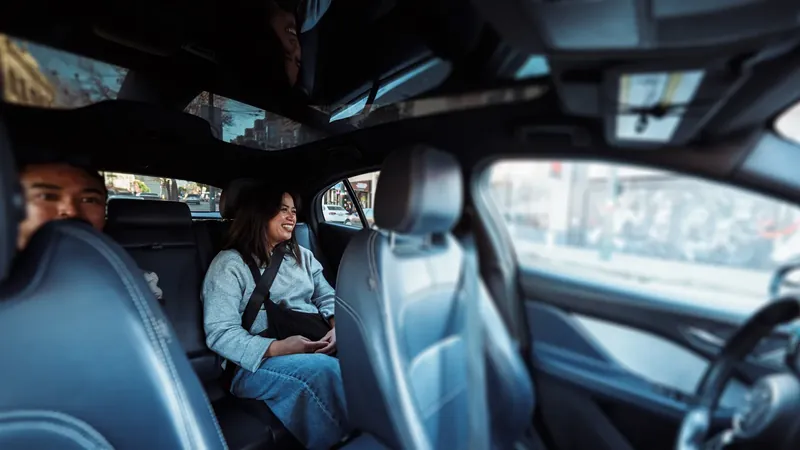
The $1 million period starts at acceptance and ends when the last requesting rider departs
A prearranged ride begins “when a driver accepts a ride requested by a rider,” continues while the driver transports a requesting rider, and ends “when the last requesting rider departs from the personal vehicle.” K.S.A. 8-2702(d). The drive to the pickup is already inside the $1,000,000 period.
| App status | Statute | Liability required | Uninsured and PIP |
|---|---|---|---|
| App off | Personal policy, K.S.A. 40-3107(e) | $25,000 per person, $50,000 per accident, $25,000 property damage. Not a rideshare figure. | Uninsured equal to bodily injury limits unless rejected in writing above 25/50 (40-284). PIP mandatory (40-3107(f)). |
| Logged on and available, no ride accepted | K.S.A. 8-2708(b) | $50,000 per person, $100,000 per incident, $25,000 property damage | Must meet the 40-284 and 40-3107(f) minimums “where required” |
| Accepted, driving to the pickup | K.S.A. 8-2708(c), 8-2702(d) | $1,000,000 | Same |
| Rider in the car | K.S.A. 8-2708(c) | $1,000,000 | Same |
| Last requesting rider departed, driver still logged on | Back to 8-2708(b) | $50,000, $100,000, and $25,000 | Same |
If the driver’s insurance lapses or falls short, the company pays from the first dollar
The driver or vehicle owner, the company, or a combination may provide the coverage, and it must be primary. K.S.A. 8-2708(a), (b)(2), (c)(2). If the driver’s insurance lapses or does not provide the required coverage, the company’s insurance covers the claim from the first dollar and has a duty to defend. 8-2708(d). Company coverage cannot depend on a personal insurer denying the claim first. 8-2708(e).
The driver must carry proof of coverage and, after an accident, give it on request and say whether they were logged on or on a ride. 8-2708(i). The company and insurers must share the driver’s log-on and log-off times for the 12 hours before and after the accident. K.S.A. 8-2710(e).
The Act says a company “shall not be deemed to control, direct or manage” drivers or vehicles, except by written contract (8-2702(e)), and treats drivers as independent contractors if four conditions are met (8-2722). Neither is an express bar on liability to injured people. How courts apply them is unsettled.
A personal policy may exclude everything, including PIP, while the app is on
Notwithstanding the no-fault act, a personal auto insurer may exclude all coverage while the driver is logged on or providing a prearranged ride, including liability, personal injury protection, uninsured and underinsured coverage, medical payments, comprehensive, and collision. K.S.A. 8-2710(a). The statute permits the exclusion. It does not say every personal policy uses it. K.S.A. 8-2710.
Uninsured coverage does not step up to $1 million
A Kansas auto liability policy for a vehicle registered or principally garaged in Kansas must include uninsured and underinsured coverage equal to its bodily injury limits. K.S.A. 40-284(a), (b). The named insured may reject coverage above $25,000 / $50,000 in writing, but the $25,000 / $50,000 floor cannot be rejected. 40-284(c). There is no stacking, and the total cannot exceed the highest single applicable policy. 40-284(d). K.S.A. 40-284.
The rideshare section requires coverage meeting the 40-284 minimums “where required” in both periods. Both Uber and Lyft print $25,000 / $50,000 of uninsured and underinsured coverage, including on the $1,000,000 policies. Uninsured coverage does not step up to $1,000,000.
Whether the rideshare law requires more than $25,000 / $50,000 of uninsured coverage, what “where required” covers, and whether the companies rejected higher limits in writing is unsettled.
When does the $2,000 PIP threshold matter?
Personal injury protection is mandatory in Kansas. K.S.A. 40-3107(f). The minimum benefits in K.S.A. 40-3103 are separate from the threshold:
- Medical: $4,500 per person.
- Rehabilitation: $4,500.
- Lost income: up to $900 a month for one year.
- Funeral: $2,000.
- Substitution services: $25 a day for 365 days, and survivor benefits up to $900 a month.
Those amounts are what PIP can pay. The threshold is about a lawsuit for non-pecuniary loss.
K.S.A. 40-3117 applies to a tort action against the owner, operator, or occupant of a motor vehicle, or against a person legally responsible for the acts or omissions of that owner, operator, or occupant. In that case, damages for pain, suffering, mental anguish, inconvenience, and other non-pecuniary loss are available only if one of two things is true.
The injury required medical treatment of a kind described in the no-fault act as medical benefits, and that treatment has a reasonable value of $2,000 or more. Or the injury consists in whole or in part of permanent disfigurement, a fracture to a weightbearing bone, a compound, comminuted, displaced, or compressed fracture, loss of a body member, permanent injury within reasonable medical probability, permanent loss of a bodily function, or death.
The $2,000 test is the one that matters when the injury is not on that list and the person still wants those non-pecuniary damages. It does not replace PIP. It does not change the liability floors in K.S.A. 8-2708: $50,000 per person, $100,000 per incident, and $25,000 for property damage while the driver is logged on and available, and $1,000,000 from acceptance until the last requesting rider departs. It does not raise the uninsured and underinsured coverage printed on the Uber and Lyft certificates above $25,000 / $50,000.
The statute says the charges actually made for medical treatment are not conclusive of reasonable value. Evidence that the reasonable value was a different amount is admissible. A person entitled to free medical and surgical benefits meets the dollar test by showing the treatment had an equivalent value of at least $2,000. Ordinary and necessary services normally performed by a nurse, if a relative or a member of the household provided them, may be included at their reasonable value. K.S.A. 40-3117.
Meeting the threshold does not decide fault. Under K.S.A. 60-258a, a claimant who is 50 percent at fault recovers nothing.
Uber prints PIP and 25/50 uninsured coverage in both periods
Uber’s Kansas certificate is issued by Farmers Insurance Company, Inc., NAIC 21628, for March 1, 2026 to March 1, 2027. Uber certificate PDF.
| What the form describes | Policy | Liability printed | PIP and uninsured printed |
|---|---|---|---|
| Logged in and available, no acceptance recorded | 606715836 | $50,000 / $100,000 / $25,000 | PIP included; uninsured and underinsured $25,000 / $50,000 |
| Acceptance recorded, en route to pickup or traveling to the destination | 606715837 | $1,000,000 combined single limit | PIP included; uninsured and underinsured $25,000 / $50,000 |
| Physical damage on accepted trips | 606715837PD | Physical damage coverage | Not stated |
Lyft prints three policies, each with PIP and 25/50 uninsured coverage, and no periods
Lyft’s certificate says “Evidence of Insurance for the state of Kansas.” The insurer is State Farm Fire and Casualty Company, NAIC 25143, and the policies run October 1, 2026 to October 1, 2027. Lyft certificate PDF.
| Policy | Label printed | Liability printed | Uninsured and PIP printed |
|---|---|---|---|
| 0000009-D01-16 | Auto liability | $1,000,000 combined single limit | $25,000 / $50,000; PIP $4,500 medical, $4,500 rehab |
| 0000010-D01-16 | Auto liability | $1,000,000 combined single limit | $25,000 / $50,000; PIP $4,500 medical, $4,500 rehab |
| 0000008-D01-16 | Non-owned autos only | $50,000 / $100,000 bodily injury, $25,000 property damage | $25,000 / $50,000; PIP $4,500 medical, $4,500 rehab |
The remarks list $2,500 comprehensive and collision deductibles. No ride period is printed for any policy, so the certificate doesn’t say which policy covers which app status.
50 percent fault recovers nothing, and the deadlines are two years
A claimant recovers only if their negligence is less than the negligence of the parties they claim against, and damages are reduced by their share. A 50/50 split recovers nothing. Each defendant pays only its own share; liability is several, not joint. K.S.A. 60-258a. K.S.A. 60-258a.
- Personal injury: two years. 60-513(a)(4).
- Property damage: two years. 60-513(a)(2).
- Wrongful death: two years. 60-513(a)(5).
The period starts when the act first causes substantial injury or the injury becomes reasonably ascertainable, but never more than 10 years after the act. 60-513(b). K.S.A. 60-513.
The $350,000 pain-and-suffering cap was struck down for injury cases
K.S.A. 60-19a02 still reads $350,000 per party for noneconomic damages. In Hilburn v. Enerpipe Ltd., No. 112,765 (June 14, 2019), an accident case, the Kansas Supreme Court held that cap violates the jury-trial right in section 5 of the Kansas Constitution Bill of Rights. Hilburn v. Enerpipe.
Punitive damages
The jury decides whether punitive damages are allowed, and the judge sets the amount in a separate proceeding. They require clear and convincing evidence of willful or wanton conduct, fraud, or malice. They are capped at the lesser of the defendant’s highest annual gross income in the prior five years or $5,000,000, or at 1.5 times the profit if the misconduct was more profitable than that. An employer is not liable for an employee’s punitive conduct unless it was authorized or ratified. K.S.A. 60-3702. K.S.A. 60-3702.
Government liability is capped at $500,000 per occurrence, and cities and counties need written notice first
Under the Kansas Tort Claims Act, liability for all claims from a single occurrence cannot exceed $500,000, unless the government bought insurance with higher limits. K.S.A. 75-6105(a), 75-6111(a). No punitive damages or prejudgment interest are allowed against a governmental entity. 75-6105(c). K.S.A. 75-6105.
Before suing a city, county, or other municipality, a claimant must file written notice with its clerk or governing body, including the facts, the injury, and the amount of damages requested. No suit may be filed until the claim is denied or 120 days pass, and the claimant has at least 90 days after denial to sue. K.S.A. 12-105b(d). K.S.A. 12-105b.
The immunity sections were amended in 2026.
Stop, give aid, and report to police for $1,000 in damage or any injury
- Stop and remain: after an accident with injury, death, or damage to an attended vehicle or property, stop immediately and stay. Leaving an injury or death accident can be a felony. K.S.A. 8-1602.
- Information and aid: give name, address, and registration; on request show your license, insurer, and policy number; and render reasonable assistance. K.S.A. 8-1604.
- Police report: if no officer is present, report immediately if apparent damage is $1,000 or more or anyone is hurt or killed. 8-1604(b).
- Officer reports: go to KDOT within 10 days and are not confidential. K.S.A. 8-1611.
Rideshare companies must keep trip records for at least one year. K.S.A. 8-2717. K.S.A. 8-1604.
Driverless cars need ordinary coverage, and the rideshare tiers are unsettled
Driverless-capable vehicles may operate with no human driver if they meet the statute’s conditions, and the owner must file a law enforcement interaction plan with the Kansas Highway Patrol. The engaged system is deemed to perform the driver’s acts. K.S.A. 8-2902. The owner needs ordinary insurance or financial security, with no higher amount set. 8-2903. Driverless ride networks are allowed and may share an app with human drivers, and the Highway Patrol regulates them exclusively. 8-2905, 8-2906. K.S.A. 8-2902.
Whether the 8-2708 limits apply to driverless trips is unsettled.
Wichita, Kansas City, Overland Park, and Topeka
The main markets are Wichita, Kansas City, Overland Park, Topeka, and Wichita Dwight D. Eisenhower National Airport. School districts may contract with rideshare companies, which must name the district as an additional insured. K.S.A. 8-2721, 8-2708(f).
What decides which floor and which benefits apply
- Whether the driver was logged off, logged on and available, had accepted a ride, or was carrying riders, and when the last requesting rider departed.
- The 12-hour log-on and log-off record around the accident. K.S.A. 8-2710(e).
- Your PIP claim, and medical records showing whether the injury meets the $2,000 or serious-injury threshold.
- The driver’s personal policy, any rideshare exclusion, and whether it lapsed.
- Your own uninsured coverage, and any written rejection above $25,000 / $50,000.
- Fault allocations, because 50 percent fault recovers nothing.
- The accident date, for the two-year deadline, and written notice if a city or county is involved.
Latest from Kansas
Start with PIP, then pin down when the ride was accepted
In Kansas, acceptance moves liability to $1,000,000, PIP pays first, and uninsured coverage stays at $25,000 / $50,000 on both certificates. A free review can sort out which policies apply to your accident.