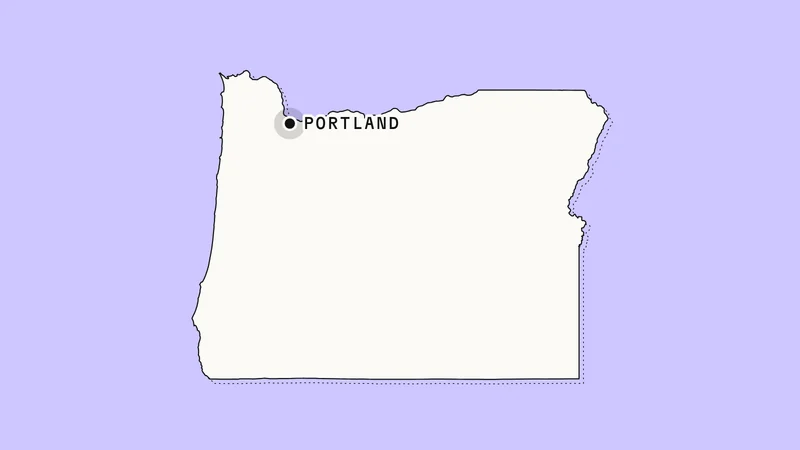
Does Portland use a different Uber and Lyft insurance rule than the rest of Oregon?
Yes, if the City of Portland regulates that company. Portland’s code sets its own periods, including a $1 million liability figure and a $1 million uninsured-motorist figure after a match is accepted. Those figures are city text. They are not a statewide acceptance statute.
Elsewhere in Oregon, this page did not find an enacted rideshare schedule of $50,000 / $100,000 / $25,000 before acceptance and $1,000,000 after acceptance. 2019 House Bill 3023 would have imposed that schedule. It was not enacted. The detail of that bill is lower on this page.
The enacted statewide floor for driving is ordinary financial responsibility. ORS 806.070 sets $25,000 because of bodily injury to or death of one person in any one accident, $50,000 because of bodily injury to or death of two or more persons in any one accident, subject to the one-person limit, and $20,000 because of injury to or destruction of the property of others in any one accident. The property-damage floor is $20,000, not $25,000.
What state law does require of a transportation network company is personal injury protection. ORS 742.520 says the company shall provide each affiliated driver a motor vehicle liability policy with those benefits. The section does not print a liability dollar. It does not say $1 million starts when the driver accepts a request. A figure on an Uber or Lyft certificate is a third text. It is not the statute, and it is not automatically the Portland code.
Oregon & the West
Three texts, not one number
Start with the place. Then read the statute, the city code, and the certificate as separate documents. They do not use the same trigger, and they do not set the same dollars.
| Question | Elsewhere in Oregon | Portland, if the city regulates the company |
|---|---|---|
| Where the rule is written | ORS 806.070 for the driving floor. ORS 742.520 for the company’s personal-injury-protection duty. | Portland City Code 16.40.230, read October 3, 2026. City law. Not statewide. |
| Liability while the app is on and the driver is waiting | No separate waiting-period statute was found. The driving floor stays $25,000 / $50,000 / $20,000. | Period 1: primary insurance of at least $50,000 per person and $100,000 per incident for death and injury, and $25,000 for property damage, plus other state compulsory coverage. |
| Liability after acceptance, including the drive to the pickup and the time a passenger is in the car | No enacted $1,000,000 acceptance floor was found. Acceptance does not raise ORS 806.070. | Periods 2 and 3: at least $1,000,000 combined single limit for death, personal injury, and property damage per incident. |
| Uninsured motorist coverage | ORS 742.502. The default matches bodily-injury liability limits unless a named insured elects lower limits in writing. The election cannot go below $25,000 / $50,000. This page did not find a sentence that allows a total rejection. | Periods 2 and 3 also require $1,000,000 combined single limit underinsured and uninsured motorist coverage. The city’s sentence includes property damage. State uninsured motorist coverage under ORS 742.500 is bodily injury or death. |
| Personal injury protection | ORS 742.520 requires it. The dollar schedule is ORS 742.524, not $1,000,000. Whether app-on waiting is inside the statute’s window is not settled. | The city code does not replace that schedule. It adds “any other state compulsory coverage to the extent required by law” in period 1. |
Whether any city other than Portland sets a different auto limit was not found in the sources used here. That gap is not a finding that no other city has a rule. Check the local code. House Bill 3023 would have made transportation-network-company regulation exclusive to the state, with a narrow airport exception. It did not pass. The failed bill is not a preemption statute.
The statewide driving floor is $25,000 / $50,000 / $20,000
Quoted from ORS 806.070(2), the schedule of payments is:
- $25,000 because of bodily injury to or death of one person in any one accident;
- subject to that limit for one person, $50,000 because of bodily injury to or death of two or more persons in any one accident; and
- $20,000 because of injury to or destruction of the property of others in any one accident.
A policy used to comply must provide at least those limits. ORS 806.080. The history line on the legislature’s chapter page for that schedule ends at 2021 c.630 §87. The 2025 edition history line on ORS 806.070 ends at 2021. The 2026 regular-session amendment table amends ORS 806.020, not ORS 806.070. The 25/50/20 figures are the current ORS 806.070 text. They are not the Portland figures, and they are not the figures printed on the Uber or Lyft certificates. A $25,000 property-damage number on a certificate, or in Portland period 1, is not the state floor.
This page did not find an enacted statute that sets a separate liability number for “logged on,” “accepted,” or “passenger in the vehicle.” The liability floor that applies because the person is driving is ORS 806.070, unless some other law applies for a reason other than the app. Check with an Oregon attorney before relying on a rule that sets a separate transportation-network-company liability dollar. This page did not find an enacted statute that requires the Oregon Department of Transportation to license transportation network companies. House Bill 3023 would have required that license. It did not pass.
The table below is state law only. It is not Portland’s three periods, and it is not what a certificate prints.
| App status at impact | Liability state law requires | Personal injury protection under ORS 742.520 |
|---|---|---|
| Logged off | At least $25,000 / $50,000 / $20,000 if the person is driving. ORS 806.070. Driving uninsured means operating a motor vehicle on a highway or premises open to the public without a policy that meets ORS 806.080, or without other satisfactory proof of compliance on file. ORS 806.010. | Outside ORS 742.520(1)(d). If the policy is a motor vehicle liability policy issued for delivery in Oregon covering a private passenger motor vehicle, personal injury protection is still required under ORS 742.520(1)(a) and ORS 742.524. |
| App on, waiting for a match | No statute was found that raises the floor above 25/50/20 because the app is on. | The statute is written for the time the driver operates the vehicle to provide transportation services to passengers. Whether being available to receive requests is inside those words is not settled. |
| Request accepted, driving to the pickup, passenger not yet in the car | No state $1,000,000 liability floor was found. Acceptance does not raise the ORS 806.070 floor. | Whether that drive, before any passenger is in the car, is “to provide transportation services to passengers” is not settled. State law does not use an acceptance test for this benefit. |
| Passenger in the vehicle | Still no state $1,000,000 liability floor was found. Financial responsibility remains 25/50/20 unless a complying policy provides more. | These are the words that fit ORS 742.520(1)(d) most closely. The statute still does not say the window runs until the passenger exits. If this is the window, the benefits must cover the driver, passengers occupying the vehicle, and pedestrians struck by it. The dollar content is ORS 742.524, not $1,000,000. |
| Passenger has left, driver still logged on | Back to the ordinary 25/50/20 floor if no other coverage is in force. There is no statutory tail. | Whether ORS 742.520(1)(d) continues after the passenger gets out, while the driver is still on the app, is not settled. |
ORS 742.518(12) defines a transportation network company by the app that connects a prospective passenger with a driver who uses a personal motor vehicle, for compensation, in affiliation with that company. The enacted definition does not mention delivery. 2023 House Bill 2051 would have extended the personal-injury-protection rules to delivery. It has no chapter number. It is not law. A delivery trip, a taxi trip, or a limousine trip is outside these passenger rideshare rules.
Personal injury protection follows the statute’s words, not an acceptance test
The insurance section that mentions a transportation network company, and that is in force, is ORS 742.520. The enrolled act, Oregon Laws 2021, chapter 222, was approved June 11, 2021, and is effective January 1, 2022. It applies to policies issued or renewed on and after that date, and to companies that conduct operations on and after that date. An accident before January 1, 2022 is not governed by the transportation-network-company sentences in chapter 222. The 2026 regular-session table of sections amended or repealed does not list ORS 742.518 or ORS 742.520.
Quoted from ORS 742.520(1)(b): “A transportation network company shall provide a motor vehicle liability policy with personal injury protection benefits to each driver who operates a personal motor vehicle in affiliation with the transportation network company.”
The trigger is not acceptance, and it is not a test that ends when the last rider departs. ORS 742.520(1)(d) uses this window: “at all times during which the driver operates the personal motor vehicle or the taxi to provide transportation services to passengers in affiliation with the transportation network company or the taxi company.” In that window, the benefits must cover the driver, occupying passengers, and pedestrians struck by the vehicle. The same words appear in the enrolled act.
ORS 742.518 defines a taxi company separately. The Uber and Lyft certificates describe a transportation-network-company driver, or Lyft period rows. They do not say a taxi or a limousine is a covered auto.
ORS 742.520 does not define a prearranged ride. It does not say coverage begins at acceptance or ends when the passenger exits or the app marks the trip complete. Whether the window includes app-on waiting, the drive to the pickup, the stop before the passenger gets out, or only the time a passenger is being transported, is not settled.
The section does not say the driver, the company, or a combination may satisfy a liability schedule, because it has no liability schedule. It does not say company coverage is excess, and it does not say it is pro rata.
Portland’s code is a separate schedule
Portland City Code 16.40.230 is city law for a transportation network company the city regulates. Check with an Oregon attorney before assuming state law overrides those city dollars.
The city defines three periods. These names are not ORS 742.520, and they are not pasted onto the state personal-injury-protection trigger.
- Period 1: the driver has logged into the app. The app is open and the driver is waiting for a match.
- Period 2: a passenger match has been accepted. The passenger is not yet picked up. The driver is on the way.
- Period 3: the passenger is in the vehicle and until the passenger exits at the destination.
From 16.40.230 G, the code says the company is to maintain:
- Period 1: primary insurance of at least $50,000 per person for death and injury, $100,000 per incident for death and injury, and $25,000 for property damage, plus any other state compulsory coverage. The city’s $25,000 property-damage figure is not the ORS 806.070 floor of $20,000.
- Periods 2 and 3: primary insurance of at least $1,000,000 combined single limit for death, personal injury, and property damage per incident, and $1,000,000 combined single limit underinsured and uninsured motorist coverage for death, personal injury, and property damage per incident.
The city’s $1 million uninsured-motorist sentence includes property damage. That sentence is not ORS 742.502. It is not Uber’s “$1,000,000 per accident” wording. It is not a liability dollar for Lyft policy ORBA3T6624548271. The state statute does not require this $1 million of uninsured motorist coverage. The city does, for a company it regulates, in periods 2 and 3.
Besides the auto limits, 16.40.230 F requires commercial general liability of not less than $1,000,000 per occurrence and $2,000,000 aggregate. Subsection C lists worker’s compensation and employer’s liability “as required by state law.” That parenthesis is not a finding that every driver is a subject worker, and it is not a dollar.
The city code does not use one voice about whose policy responds. Subsection B says all periods may be covered by the company, the driver, or a combination. Subsection G describes coverage maintained by the company. Subsection H requires the company to prove insurance that satisfies the three periods if the driver’s insurance has lapsed or falls short. Subsection M.3 says the subsection G coverage must be provided by the company on a primary basis from the first dollar unless a driver policy expressly states otherwise. How B, G, H, and M.3 fit on one claim is not settled. Those sentences are city text. They do not appear in ORS 742.520.
A company the city regulates must also tell drivers, in writing, that they are not required to buy a personal policy covering this use as a condition of driving, that the city’s required coverage must be provided by the company from the first dollar unless a driver policy expressly says otherwise, that the company’s insurance does not include collision unless the company policy expressly says otherwise, and that the driver’s personal policy may be subject to cancellation under ORS 742.562 or may not cover this use.
Subsections E and L restrict the city’s permit insurance to a licensed insurer or an eligible surplus-lines insurer, and they require an A.M. Best rating of A- or better, or an alternative in an administrative rule. That is a city permit condition. It is not a statewide placement statute.
Ordinance 192209, effective July 23, 2026, amended Code sections 16.40.030 and 16.40.240, on ride fees and a drivers’ resource center. The city’s change log does not say it amended 16.40.230. It did not change the insurance dollars. The insurance text is the code section as published on October 3, 2026.
An accident after the vehicle has stopped, before the passenger exits, is inside Portland period 3 if the city code applies. That ending point is the city’s text. It is not Uber’s “traveling to the final destination” wording, and it is not ORS 742.520. Lyft’s certificate uses the same period numbers and does not define them. Matching numbers are not a definition of Lyft’s labels.
Port of Portland permit page
The Port of Portland roadway-provider permit page, read October 3, 2026, says a person who would like to offer rides at the airport must obtain a permit, and must already have a City of Portland permit. The certificate bullet states commercial general liability, auto liability, and workers’ compensation, in amounts not less than $1,000,000 per occurrence or per accident, an A.M. Best rating of A- or better or equivalent, and the Port named as additional insured. The page does not mention uninsured motorist coverage. It does not use period 1, period 2, or period 3. Whether an Uber or Lyft pickup must satisfy that bullet is not settled. The page does not say whether the $1 million applies separately to each line or as one certificate condition.
The certificates print their own limits
A certificate is evidence of insurance. It is not the policy, and it is not the statute. Policy numbers, dates, and blank cells are set out lower on this page. The split that matters is shorter than that.
Uber’s certificate, linked from the Oregon anchor on Uber’s insurance page, does not print the word Oregon. Uber certificate PDF. Before acceptance it prints $50,000 / $100,000 / $25,000 of liability and $25,000 / $50,000 of uninsured motorist coverage. After recorded acceptance it prints a $1,000,000 combined single limit and $1,000,000 per accident of uninsured motorist coverage. Those are certificate figures. They are not ORS 806.070, and they are not labeled as Portland coverage.
Lyft’s certificate says it is evidence of insurance for Oregon. Lyft certificate PDF. It labels Period 1, Period 2, and Period 3 and does not define them. Period 1 prints $50,000 / $100,000 / $25,000 of liability and $50,000 / $100,000 of uninsured motorist coverage. Period 2 prints a $1,000,000 combined single limit. Period 3 prints a $2,500 physical-damage deductible and no liability dollar. The remarks say Period 2 and Period 3 include $1,000,000 combined single limit of uninsured motorist coverage, and that the automobile policies include personal injury protection. No personal-injury-protection dollar is printed.
Uber and Lyft do not print the same uninsured motorist limits. Uber’s waiting form is at the ORS 806.070 bodily-injury floor. Lyft’s Period 1 row matches that row’s bodily-injury liability. Neither certificate is a written lower-limits election under ORS 742.502. Neither prints a personal-injury-protection dollar. Workers’ compensation is marked N/A on both. No employers’ liability dollar is printed.
The PIP schedule is in ORS 742.524, and a lawsuit is still available
Personal injury protection is required under the statute now in force. 2025 House Bill 3636 would have made the decision to take it optional. It has no chapter number. It is not law. Oregon is not a no-fault state that bars a lawsuit. ORS 742.520(5) says the potential existence of a tort claim does not relieve an insurer of the duty to pay these benefits.
Two duties sit next to each other. Every motor vehicle liability policy issued for delivery in Oregon that covers a private passenger motor vehicle must provide personal injury protection to the named insured, resident family, children reared as the insured’s own, passengers occupying the insured motor vehicle, and pedestrians struck by it. ORS 742.520(1)(a). The company must provide a policy with personal injury protection to each affiliated driver, and during the subsection (1)(d) window that coverage must include the driver, occupying passengers, and struck pedestrians.
The content is ORS 742.524(1), unless the insurer provides more favorable benefits under ORS 742.532. The 2021 act did not amend this dollar schedule. The history of ORS 742.524 ends at 2015. Unless the policy is more favorable, the schedule is:
- Reasonable and necessary medical, hospital, dental, surgical, ambulance, and prosthetic expenses incurred within two years, not more than $15,000 in the aggregate.
- If the person is usually engaged in paid work and disability continues at least 14 days, 70 percent of lost income, maximum $3,000 per month, maximum 52 weeks.
- If the person is not usually in paid work, and disability continues at least 14 days, essential services by someone who is not a relative and does not live in the household, maximum $30 per day, maximum 52 weeks.
- Reasonable and necessary funeral expenses within one year, not more than $5,000.
- If the injured person is a parent of a minor child and is hospitalized at least 24 hours, $25 per day for child care, not more than $750.
An insurer may offer deductibles of up to $250 for the medical, wage, and essential-services benefits, for the insured person and resident family. ORS 742.524(2). That offer is not a statutory deductible on a passenger’s benefits. Neither certificate prints these dollar amounts or a personal-injury-protection deductible. The personal-injury-protection terms on the policies themselves are not on these certificates.
ORS 742.520 does not require a separate medical-payments coverage. Provider charges are tied to the workers’ compensation fee schedules in ORS 656.248. ORS 742.525. That is a billing cap. It is not a liability limit.
ORS 742.526 is the primary and excess map. Benefits for the insured, resident family, and passengers injured while occupying the insured motor vehicle are primary. Benefits for the insured and resident family injured as pedestrians are primary. Benefits for the insured and resident family injured in a vehicle not insured under the policy are excess. Benefits for other pedestrians struck by the insured vehicle are excess over other collateral benefits. The policy may reduce or eliminate benefits when the injured person is entitled to workers’ compensation or similar medical or disability benefits. ORS 742.526(2). That permission is not a statement that transportation-network-company drivers have workers’ compensation. Which personal-injury-protection policy is primary when both a personal policy and a company policy cover the same person is not settled.
Reimbursement between insurers is reduced in proportion to the negligence of the person for whom the benefits were paid, and it cannot exceed the damages that person can legally recover. ORS 742.534(2). That is an inter-insurer rule. It is not a bar on the injured person’s tort claim. A dispute about the amount or denial of these benefits is decided by arbitration if the insurer and the beneficiary agree at the time of the dispute. ORS 742.520(6). The insured’s costs of that proceeding shall not exceed $100. ORS 742.522(1). That agreement is not mandatory arbitration of the injury claim against the driver.
Uninsured motorist coverage tracks bodily-injury liability unless a lower limit is elected in writing
Uninsured motorist coverage, which includes underinsurance, is mandatory on a motor vehicle liability policy described in ORS 742.502. The 2026 amendment table does not list ORS 742.502. The duty covers a policy insuring a natural person against liability for bodily injury or death from owning, maintaining, or using a motor vehicle, if the policy is issued for delivery in Oregon, or is issued or delivered by an insurer doing business in Oregon for a vehicle then principally used or principally garaged in Oregon.
ORS 742.502(2)(a) requires the same limits as bodily-injury liability, unless a named insured in writing elects lower limits. The named insured may not elect limits lower than the bodily-injury amounts in ORS 806.070. Those amounts are $25,000 / $50,000. The $20,000 property-damage figure is not the floor for this election. This page did not find a sentence that lets the named insured reject the coverage entirely. The certificates are not the election form.
The written election uses a Department of Consumer and Business Services form. The statute also sets a 60-day signature rule. The statement stays in force until a named insured rescinds it in writing or the bodily-injury liability limits change. There is no sentence that $1 million of liability means $1 million of uninsured motorist coverage. The state statute does not require $1 million of it. State uninsured motorist coverage, as defined in ORS 742.500(5), is for bodily injury or death. It is not property-damage coverage. Neither certificate prints a property-damage uninsured-motorist limit.
Underinsurance is part of the same coverage. It applies when the sums the insured is legally entitled to recover are greater than what the other vehicle’s liability insurance provides. That is a damages comparison. It is not a rule that looks only at whether one policy’s limits sit below the other’s.
Whether the policies on these certificates are policies that ORS 742.502(1) requires to carry this coverage, and whether a named insured signed a lower-limits election, is not settled. The named insureds on the certificates are company entities. Uber’s waiting-period uninsured motorist limit is printed below that policy’s bodily-injury liability and at the $25,000 / $50,000 floor. Whether that printed limit is a valid written election is not settled. The election form was not in the certificate file.
ORS 742.504 sets provisions a required policy must meet in a way no less favorable to the insured. For a hit-and-run claim, the statute requires physical contact, an operator or owner who cannot be identified, a report within 72 hours, and a sworn statement filed with the insurer within 30 days after that report. A phantom vehicle, with no physical contact, is separate and needs corroboration other than the testimony of the insured or of any person with an uninsured-motorist claim from the accident.
For an insured occupying a vehicle not owned by a named insured, the coverage applies only as excess over similar primary insurance, and then only to the sums the insured is legally entitled to recover. ORS 742.504(9)(a)(B). A passenger is usually in a vehicle the passenger does not own. The certificates do not decide which policy is primary. Whether a personal vehicle on one of these trips is used as a public or livery conveyance, for ORS 742.518(8) or for the excess rule in ORS 742.504(9)(b), is not settled. A passenger may still have uninsured motorist coverage on a personal policy. The exclusion below can reach the driver’s policy. It does not erase a passenger’s own policy.
A personal insurer may exclude coverage during compensated transportation
ORS 742.520(1)(e) is the statutory permission. An insurer may exclude from a private-passenger policy any coverage, including personal injury protection, for a loss while a driver is operating the vehicle to provide transportation services for compensation in affiliation with a transportation network company.
“Any coverage” is broader than personal injury protection. It can reach liability, uninsured motorist coverage, and collision if the policy is a private-passenger policy and the loss is in that window. It is permission. It is not a declaration that every personal policy already excludes this use.
The trigger is operating the vehicle to provide transportation services for compensation. It is not the words “logged on and available.” Whether subsection (1)(e) reaches app-on waiting is not settled. A personal policy may still exclude that use by its own business-use language. That would be the policy, not the subsection.
Nothing in subsection (1)(e) says the company policy becomes first-dollar coverage when the personal policy excludes the use. The company has its own duty to provide personal injury protection. This page did not find a state-law duty, in ORS 742.520, to provide $1 million of liability. A company may still buy liability above the 25/50/20 floor. That is what the certificates show. It is company coverage, not the state floor.
“Private passenger motor vehicle,” for this series, still includes the phrase “not used as a public or livery conveyance.” ORS 742.518(8). The 2021 act did not strike those words. The company duty in ORS 742.520(1)(b) does not depend on the vehicle remaining inside that definition. The exclusion in subsection (1)(e) does, because it is an exclusion from a private-passenger policy. Whether a particular car, while on one of these trips, is still a private passenger motor vehicle is not settled.
Uber’s certificate puts collision on the accepted-trip policy only. Lyft’s remarks put physical damage on Period 2 and Period 3 only, and the form does not define those periods. Waiting-period collision is not printed on either certificate.
A lapse does not create a statewide first-dollar rule
If the driver’s own policy has lapsed, state law does not say the company policy drops to the first dollar, is excess, or shares pro rata. That first-dollar sentence was in the unenrolled text of 2019 House Bill 3023. It is not in ORS 742.520. When both a personal policy and a company policy are in force and both cover the loss, the state transportation-network-company section is silent on contribution.
Portland’s first-dollar sentence and its lapse sentence are city text. They are quoted with the city code above. They conflict in wording with the city’s own combination sentence. They are not a statewide rule.
ORS 742.520 does not say the company policy must be written by an admitted insurer, and it does not set an A.M. Best rating floor. The surplus-lines and rating sentence was in the failed 2019 bill. No contract sentence in ORS 742.520 nullifies a waiver between the company and a driver.
ORS 806.010 puts the driving-uninsured duty on the person who drives. That is not a sentence that the company policy, by itself, keeps the driver’s plate legal. Whether a non-owned company policy satisfies the driver’s financial-responsibility duty, including a requirement that the policy designate the covered vehicles, is not settled. The certificates are not the policies.
Uber’s form does not print Oregon. Lyft’s Period 3 liability cell is blank.
The limits below are what the certificate files showed as of October 3, 2026. They are evidence of insurance, not the policies.
Uber: Liberty Surplus Insurance Corporation, NAIC 10725
Produced by Aon. The insured is Rasier LLC and the affiliated Rasier entities on the form. Every ACORD date box is February 25, 2026. Every policy period is March 1, 2026 through March 1, 2027. The claim line is http://t.uber.com/claims. Non-owned autos only is marked. Workers’ compensation is marked N/A.
- Before acceptance, policy ASE-665-067247-516, certificate 570118117728. $50,000 bodily injury per person, $100,000 per accident, and $25,000 property damage. The combined-single-limit cell is blank. The description is a driver logged in, available to receive requests, who has not accepted a request. Uninsured motorist coverage is included at $25,000 per person and $50,000 per accident. No personal-injury-protection dollar is printed. Whether the lower uninsured-motorist limit is a valid written election is not settled.
- After recorded acceptance, policy ASE-665-067247-526, certificate 570118117730. $1,000,000 combined single limit. The split cells are blank. The description is a driver who has recorded acceptance and is en route to the pickup or traveling from the pickup to the final destination. Uninsured motorist coverage is included at $1,000,000 per accident. The sentence does not say the $1,000,000 starts only when the passenger enters. Whether “traveling to the final destination” covers the time after arrival and before the passenger gets out is not settled.
- Physical damage, certificate 570118117729, is on policy 526 only. Comprehensive and collision deductibles are $2,500 and $2,500. The form does not say those deductibles depend on a personal policy, and it does not put them on policy 516.
Lyft: Mobilitas General Insurance Company, NAIC 10675
Opened from the Oregon link on Lyft’s proof-of-insurance page. The face says “Evidence of Insurance Only for the State of OR.” Certificate date August 13, 2026. Certificate number SEA-004219093-05. The insured is Lyft, Inc. Every dated row is October 1, 2026 through October 1, 2027. The August 13 date is before that inception. It is not the inception. The claims line is http://lft.to/submit-request.
- Period 1, policy ORBA1T6624548271. Bodily injury $50,000 per person and $100,000 per accident. Property damage $25,000. Uninsured and underinsured motorist coverage $50,000 / $100,000. The $25,000 property-damage figure is the certificate’s figure. It is not ORS 806.070’s $20,000 floor.
- Period 2, policy ORBA2T6624548271. A $1,000,000 combined single limit. No split liability dollar on that row. That limit is what the certificate prints. It is not a state statutory floor.
- Period 3, policy ORBA3T6624548271. A $2,500 physical-damage deductible. No liability dollar is printed. The $1,000,000 on the page sits on the Period 2 row. The liability limit, if any, on this policy is not settled by the certificate.
The remarks say physical damage on Period 2 and Period 3 is actual cash value or the cost of repair, whichever is less, less the $2,500 deductible. They say those two policies include uninsured and underinsured motorist coverage of $1,000,000 combined single limit. They say the automobile policies include personal injury protection. No dollar is printed for that benefit. The form does not say physical damage depends on the driver’s own comprehensive and collision. Period 3’s uninsured-motorist sentence is not equal to a printed liability limit, because no liability limit is printed on that row. Which use each Lyft period label describes is not settled on the form.
The 2019 acceptance schedule was not enacted
2019 House Bill 3023 would have required $50,000 / $100,000 / $25,000 while a driver was waiting and $1,000,000 after acceptance. It would also have included a first-dollar sentence, a surplus-lines and rating sentence, an Oregon Department of Transportation license, and state control of transportation-network-company regulation, with a narrow airport exception. OLIS, read October 3, 2026, shows the bill still in the Joint Committee on Ways and Means, with the chapter-number field blank. It has no chapter number. It is not law.
That blank chapter field is not a positive rule. It does not forbid a company from buying more insurance than ORS 806.070 requires. It does not erase Portland’s code. It means the proposed statewide schedule was not enacted.
2023 House Bill 2051 would have extended the personal-injury-protection rules to delivery. It has no chapter number. It is not law. 2025 House Bill 3636 would have made personal injury protection optional. It has no chapter number. It is not law. Do not read any of those bills as the current statute.
Fault is modified comparative, and liability is several only
ORS 31.600(1) says contributory negligence shall not bar recovery in an action for death or injury to person or property if the fault attributable to the claimant was not greater than the combined fault of all persons specified in subsection (2), but damages shall be diminished in proportion to the claimant’s fault. The 2026 amendment table does not list ORS 31.600.
Subsection (2) compares the claimant with any party against whom recovery is sought, third-party defendants who are liable in tort to the claimant, and any person with whom the claimant has settled. There is no comparison with a person who is immune, who is not subject to the court’s jurisdiction, or whose claim is barred by a statute of limitation or ultimate repose, except people who have settled.
In a two-person case, fault of 50 percent is not greater than the other person’s fault, so it is not a bar. Fault greater than the combined fault of the people subsection (2) includes is a bar. A claimant whose fault is greater than that combined fault does not recover under this section.
ORS 31.610(1) says that in a civil action arising out of bodily injury, death, or property damage, including related claims, the liability of each defendant for damages awarded to the plaintiff shall be several only and shall not be joint. A later motion can reallocate an uncollectible share. A party’s share is not increased by reallocation if the claimant’s fault is equal to or greater than that party’s fault, or if that party’s fault is 25 percent or less. ORS 31.610(3) and (4).
The time limits are not one number.
- An action for assault, battery, false imprisonment, or for injury to the person or rights of another, not arising on contract and not especially enumerated in ORS chapter 12, shall be commenced within two years. ORS 12.110(1). The 2026 amendment table does not list ORS 12.110.
- A negligent-injury action may not be commenced more than 10 years from the act or omission. ORS 12.115(1). That repose does not extend any shorter limitation, including ORS 12.110.
- An action for taking, detaining, or injuring personal property shall be commenced within six years. ORS 12.080(4).
- Wrongful death shall be commenced within three years after the injury causing the death is discovered or reasonably should have been discovered. In no case may it be commenced later than the earliest of three years after the death, or the longest applicable ultimate repose. ORS 30.020(1).
Uninsured-motorist arbitration under ORS 742.504, like personal-injury-protection arbitration, is by mutual agreement at the time of the dispute, with the same $100 cost cap. Neither is mandatory arbitration of the injury claim against the driver.
The record has to show which text applies
For an accident in Oregon, the facts that change the number are the facts that choose among the statute, the certificate, and, inside Portland, the city code.
- Whether the trip was inside Portland under a city transportation-network-company permit, or elsewhere in Oregon. The city $1 million figures are in 16.40.230. They are not a statewide statute. Whether any other city sets a different auto limit was not found here.
- Whether the driver was logged off, logged on and waiting, driving to a pickup after acceptance, transporting a passenger, or stopped with the passenger still in the car. State personal injury protection, Portland’s three periods, Uber’s two descriptions, and Lyft’s three undefined labels do not match on that line.
- Whether the trip was passenger transportation in a personal vehicle affiliated with a transportation network company. The Uber and Lyft certificates do not say they cover a taxi, a limousine, or a delivery. House Bill 2051 did not pass.
- Whether the pickup or drop-off was under a Port of Portland roadway-provider permit. That page is not 16.40.230, and it does not state an uninsured-motorist minimum. Whether an Uber or Lyft pickup must satisfy the Port’s certificate bullet is not settled.
- The driver’s personal policy, including any transportation-network-company exclusion and any uninsured-motorist lower-limits election. The certificates do not show that form.
- Which company policy number responds. For Uber, the split is printed: ASE-665-067247-516 before acceptance, and ASE-665-067247-526 after recorded acceptance. For Lyft, the form labels three periods and does not define them, and ORBA3T6624548271 has no printed liability dollar.
- Whether anyone else has uninsured motorist coverage or personal injury protection that ORS 742.504 or ORS 742.526 would treat as primary or excess. Which personal-injury-protection policy is primary, when both a personal policy and a company policy claim the same person, is not settled.
- The date of the accident. Uber’s printed period is March 1, 2026 through March 1, 2027. Lyft’s printed period is October 1, 2026 through October 1, 2027. The transportation-network-company sentences in chapter 222 apply to operations on and after January 1, 2022.
- For an uninsured-motorist hit-and-run or phantom-vehicle claim, whether the 72-hour report and the 30-day sworn statement were made, and, for a phantom vehicle, whether there is corroboration other than the claimant’s own testimony.
The certificate is evidence. The policy, the declarations, and any uninsured-motorist election form control over the certificate where they differ. Those forms were not in the certificate files. The statute controls over both on what the statute actually requires.
Latest from Oregon
Trace a $1 million figure to a certificate or to Portland, not to a statewide acceptance statute
Place the accident on the state personal-injury-protection words, on the certificate that was in force, and, if the city regulates that trip, on Portland’s own periods. Those three texts do not use the same trigger, and they do not set the same dollars. The 2019 bill that would have created a statewide acceptance tier was not enacted.